
DENZA Re-Match: Deconstructing Procedural Hurdles and Bad Faith in Indonesian IP Litigation
A critical review of the DENZA trademark litigation in Indonesia, exploring the procedural obstacles of party identification and the tactical use of trademark assignments. This article provides insights into synthesizing substantive and procedural rigor in multi-defendant trademark cancellation lawsuits.si blog
6/12/20263 min read
The ongoing DENZA litigation represents a critical juncture for foreign brand owners navigating the complex Indonesian trademark landscape. While the initial round of the dispute between BYD Company Limited and local registrants ended in a procedural dismissal, the subsequent re-match offers a sophisticated analysis of the interplay between the first-to-file principle, the pervasive doctrine of bad faith, and the rigid strictures of Indonesian civil procedure. This case serves as a vital touchstone for intellectual property practitioners who must balance substantive merit with flawless procedural execution.
The Procedural Bottleneck: Error in Persona and the Assignment of Rights
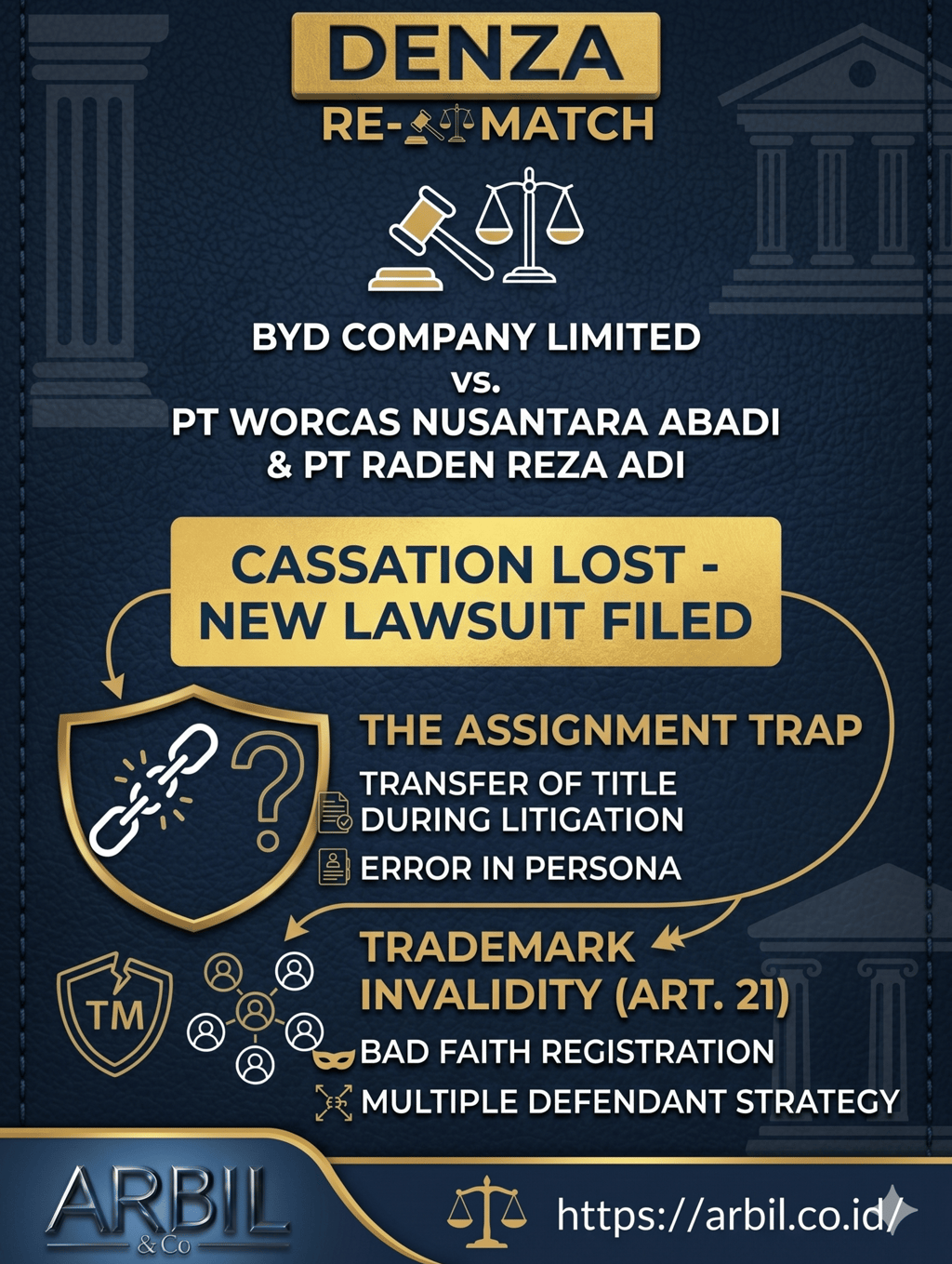
The initial litigation, registered under Decision No. 1/Pdt.Sus-HKI/Merek/2025/PN.Niaga.Jkt.Pst, culminated in a final dismissal at the Cassation level through Decision No. 1338 K/Pdt.Sus-HKI/2025. The dismissal was not predicated on a failure to prove substantive merit, but rather on a formidable procedural roadblock. By the time the lawsuit reached the Commercial Court, the defendant had already executed a private assignment of the trademark rights to a third party, PT Raden Reza Adi.
This case illustrates a recurring and difficult challenge in Indonesian IP litigation often referred to as the assignment trap. Under the Indonesian legal framework, once rights are legally assigned and recorded, or even executed via notarized deed, the standing of the original registrant is effectively neutralized in the eyes of the court. The Supreme Court ruling explicitly confirms that the failure to join the successor-in-interest at the inception of the lawsuit renders the claim susceptible to an error in persona exception. This technical deficiency effectively bars the court from reaching the substantive merits of bad faith or the "well-known mark" status that the plaintiff had meticulously prepared.
The Re-Match: Synthesizing Substantive and Procedural Rigor
In the current action, Case No. 64/Pdt.Sus-HKI/2026/PN Niaga Jkt.Pst, the plaintiff has recalibrated its legal strategy by adopting a highly sophisticated, multi-pronged approach to overcome the previous jurisdictional hurdles. By naming both the original registrant and the current assignee as co-defendants, the plaintiff aims to achieve a comprehensive strategic alignment that anticipates the defendant's previous reliance on procedural shifts.
By retaining the original registrant as a party, the plaintiff ensures that the evidence of bad faith, which constitutes the mens rea behind the initial registration, remains fully admissible and relevant to the court's consideration of whether the mark was tainted from its inception. Simultaneously, by naming the current assignee, the plaintiff ensures that any eventual cancellation order issued by the Court possesses the required legal force to bind the party currently appearing in the Directorate General of Intellectual Property registry. This dual-naming strategy effectively closes the loophole of post-facto assignments.
Legal Dialectics: Beyond the First-to-File Doctrine
The DENZA case compels us to re-examine the inherent tension between Indonesia’s first-to-file system and the international obligation to protect well-known reputation. Unlike standard cancellation actions, this re-match brings into sharp relief a foundational question for the Indonesian judiciary: will the courts prioritize the sanctity of the register, specifically the constitutive nature of registration, or the equitable doctrine of bad faith when a registrant exhibits a demonstrable pattern of acquiring marks associated with global industry leaders?
The core issue remains whether a registrant can effectively insulate a mark from cancellation simply by performing a post-facto assignment to a third party, or whether the doctrine of bad faith under Article 21(3) of the Trademark Law imposes a permanent legal taint on the mark that survives subsequent assignments. If the judiciary allows the former, it risks incentivizing the use of corporate restructuring as a shield against legitimate IP enforcement. If it leans toward the latter, it signals a significant strengthening of IP protections in Indonesia.
As this case proceeds to the evidentiary phase, the legal community is observing with intense interest whether this multi-defendant strategy will successfully bypass the formalistic barriers encountered in the previous round. Will the Court look past the technical assignment of rights to the underlying conduct and business patterns of the parties involved? Or will the procedural rigidity that characterized the first-instance courts in the previous dispute persist in the face of these new tactical refinements?
The DENZA re-match serves as a poignant reminder that in the demanding arena of international IP litigation, substantive success is inextricably linked to procedural precision. The case reflects the inherent complexity of trademark disputes, where victory depends not only on the undisputed strength of a brand's reputation but on the practitioner’s diligence in mapping the legal position of all parties and proactively anticipating administrative shifts throughout the entire life cycle of the dispute.
At ARBIL & Co., we are committed to providing strategic solutions to navigate the complexities of trademark disputes in Indonesia. If you require legal assistance regarding non-use cancellation actions, trademark invalidity actions, or the development of comprehensive trademark protection strategies, please contact our expert team at info@arbil.co.id.
Get in touch with us
We provide reliable legal solutions.
CONSULTATION
Contact Us
info@arbil.co.id
+62 8 99999 6160
© 2025. All rights reserved.
Jl. M.H. Thamrin No. 12, Lantai 5 Unit A.6, RT. 2 / RW. 1, Kebon Sirih, Menteng, Jakarta Pusat, DKI Jakarta 10340 - Indonesia
By submitting this form, you agree to receive marketing communications, including newsletters, promotions, and offers, from ARBIL & Co. We respect your privacy and will never share your information with third parties. You can unsubscribe at any time by clicking the "unsubscribe" link in any email we send