
Comparing the "SINOCARE" Trademark Cancellation Action and Potential Trademark Invalidity Lawsuit in Indonesia
An analysis of the trademark dispute between Sinocare Inc. and PT. Sky One Healthcare in Indonesia, focusing on the non-use cancellation action and potential trademark invalidity based on well-known trademark rights and bad faith, with insights into Indonesia’s trademark enforcement.
4/30/20265 min read
Trademark disputes in Indonesia are often complex, not only involving the question of who registered the trademark first but also how a trademark is used, whether it has international recognition, and whether there is bad faith in its registration. For international trademark attorneys, understanding the available legal strategies in Indonesia is crucial, particularly when it comes to non-use cancellation actions and trademark invalidity actions based on well-known trademarks or bad faith.
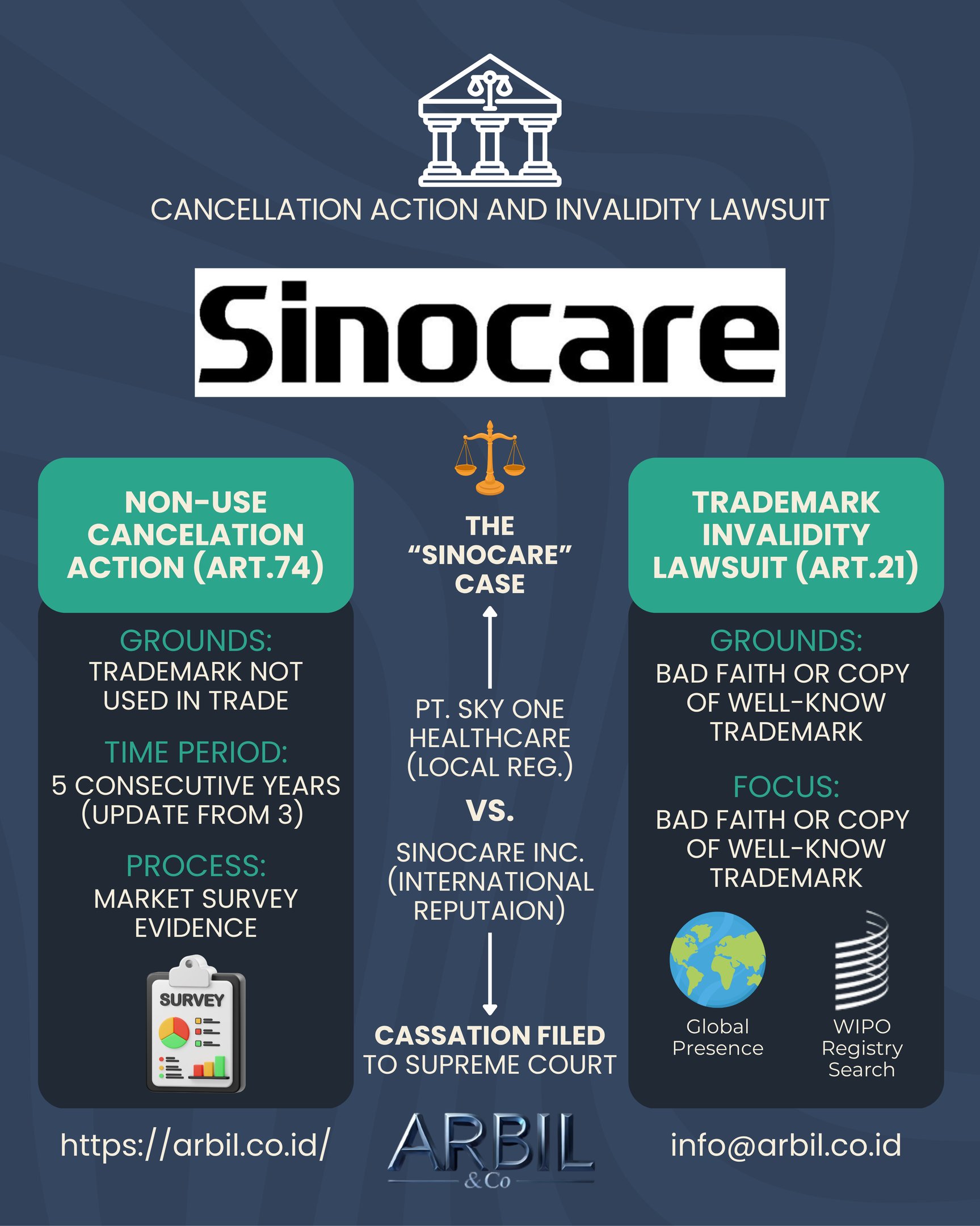
One of the notable cases is the ongoing trademark dispute between Sinocare Inc. and PT. Sky One Healthcare concerning the "SINOCARE" trademark. In this case, Sinocare Inc. filed a non-use cancellation action against PT. Sky One Healthcare’s "SINOCARE" trademark for blood glucose meter products. The initial ruling by the Commercial Court rejected the claim, and Sinocare Inc. has since pursued cassation with the Supreme Court of Indonesia through its legal counsel.
Non-Use Cancellation Action in the "SINOCARE" Case
A non-use cancellation action in Indonesia is governed by Article 74(1) of Law No. 20 of 2016 on Trademarks and Geographical Indications. However, it is important to note that this provision’s interpretation has evolved, particularly following Constitutional Court Decision No. 144/PUU-XXI/2023, which expanded the non-use period from 3 years to 5 years for a trademark not being used in commerce.
The full text of Article 74(1) now reads:
"A registered trademark may also be canceled by a third party with an interest through a lawsuit to the Commercial Court on the grounds that the trademark has not been used for 5 (five) consecutive years in the trade of goods and/or services from the date of registration or last use."
In the "SINOCARE" case, Sinocare Inc. filed a non-use cancellation action against PT. Sky One Healthcare, which submitted the trademark application for "SINOCARE" in Indonesia on July 9, 2015. The trademark was registered under Class 10 for blood glucose meter products.
A non-use cancellation action essentially focuses on proving whether the trademark has been actively used in commerce as indicated by the registered trademark. In this case, Sinocare Inc. contended that the trademark "SINOCARE" owned by PT. Sky One Healthcare had not been used in trade for more than five consecutive years, as required by Indonesian trademark law. To support this claim, Sinocare Inc. presented evidence in the form of market surveys, including checks on offline stores and online marketplace platforms in Indonesia. This approach illustrates that in non-use cancellation actions, the burden of proof regarding the use or non-use of the trademark in the market is crucial.
Potential Trademark Invalidity Lawsuit: Well-Known Trademark and Bad Faith
In addition to the non-use cancellation action, the "SINOCARE" case can also be examined from the perspective of a potential trademark invalidity lawsuit. Unlike non-use cancellation, which addresses the lack of use of a trademark in trade, a trademark invalidity action challenges the validity of a trademark registration based on its origin, particularly focusing on whether the trademark was registered in bad faith or as a copy of a well-known trademark.
Sinocare Inc., as the owner of the "SINOCARE" trademark, has been in existence since 2002, with the "SINOCARE" brand already well-established in international markets.
Based on data obtained from WIPO, information shows that the "SINOCARE" trademark owned by Sinocare Inc. was filed in countries such as the United States, Vietnam, Thailand, and India before the PT. Sky One Healthcare trademark application in Indonesia. It is also assumed that Sinocare Inc. holds trademark registrations for "SINOCARE" in its home country, China. This fact strengthens the argument that the "SINOCARE" trademark is already internationally recognized and registered in multiple countries, providing a solid foundation for Sinocare Inc. to file a trademark invalidity lawsuit in Indonesia.
In this context, Sinocare Inc. could potentially file a trademark invalidity action based on Article 21 of the Indonesian Trademark Law, which allows for the cancellation of trademarks that are found to be copies of well-known trademarks already registered. The process for filing such a lawsuit would involve proving that the "SINOCARE" trademark owned by PT. Sky One Healthcare is a copy of the well-known trademark already registered by Sinocare Inc. in other countries, demonstrating bad faith on the part of PT. Sky One Healthcare in registering a trademark so similar to an existing, well-known trademark, and presenting evidence that the "SINOCARE" trademark owned by Sinocare Inc. has been widely used in global markets and recognized by international consumers long before PT. Sky One Healthcare’s trademark application in Indonesia.
Thus, a trademark invalidity lawsuit and a non-use cancellation action should not be seen as mutually exclusive but rather complementary legal strategies, each addressing different aspects of trademark law. A non-use cancellation action focuses on the post-registration use of a trademark, while a trademark invalidity action addresses the validity of the trademark from the outset.
Judge’s Consideration on the Trademark Renewal Process
According to the judge’s reasoning, the trademark renewal process submitted by PT. Sky One Healthcare became a crucial point in this dispute. The trademark "SINOCARE" owned by PT. Sky One Healthcare was successfully renewed until 2035. In the context of a non-use cancellation action, the renewal of the trademark can be viewed as an administrative indicator that the trademark owner has affirmed the continued use of their trademark and that their products are still being produced and traded.
However, from a broader perspective, trademark renewal does not necessarily preclude the possibility of an invalidity lawsuit. If there is sufficient legal ground to argue that the trademark registration is problematic from the beginning, such as being too similar to an existing well-known trademark or registered in bad faith, then a trademark invalidity action remains a viable legal option.
Cassation as the Next Legal Step
Following the unsuccessful non-use cancellation action at the Commercial Court level, Sinocare Inc. has proceeded to file a cassation to the Supreme Court of Indonesia through its legal counsel. Cassation becomes a crucial step in this dispute as the decision by the Supreme Court will serve as a higher binding ruling that could affect further decisions in the trademark dispute.
For foreign trademark owners, the cassation process also highlights that trademark disputes in Indonesia may require layered litigation strategies. Crafting legal arguments, proving use or non-use, documenting trademark reputation, and understanding the practices of both the Commercial Court and the Supreme Court are essential factors in ensuring effective trademark protection in Indonesia.
The "SINOCARE" case offers valuable lessons for international trademark attorneys managing global trademark portfolios in Indonesia. First, foreign trademark owners must ensure their trademarks are filed early in Indonesia, especially if the trademark has been used or promoted internationally. Second, when facing local trademarks that are identical or similar, the choice of legal strategy must align with the available facts. If the issue at hand is the non-use of a trademark, then non-use cancellation actions may be the appropriate route. However, if there is a history of international registration, trademark reputation, and indications of bad faith, then trademark invalidity actions should also be considered.
Third, evidence is key. In non-use cancellation actions, market evidence and proof of trademark usage are paramount. Meanwhile, in invalidity actions based on well-known trademarks and bad faith, evidence of international reputation, registration in various countries, promotion, sales, publicity, distribution, and consumer recognition are crucial elements.
The comparison between non-use cancellation actions and trademark invalidity actions in the "SINOCARE" case demonstrates that trademark disputes in Indonesia require not only procedural analysis but also strategic considerations. Non-use cancellation actions and trademark invalidity actions each have distinct characteristics, legal bases, and burdens of proof. Understanding these differences is crucial for foreign trademark owners and legal advisors seeking to protect their interests in Indonesia.
For foreign trademark owners, multinational companies, and international trademark attorneys, working with experienced Indonesian IP counsel is critical when evaluating the best approach to challenge or defend a trademark registration in Indonesia. Every case requires careful consideration of the factual background, registration history, market use, reputation, and available evidence.
At ARBIL & Co., we assist clients in navigating Indonesia’s trademark landscape, including trademark prosecution, non-use cancellation actions, trademark invalidity actions, enforcement, opposition strategy, and litigation before the Indonesian Commercial Courts and the Supreme Court. Our Intellectual Property team combines technical trademark knowledge with practical litigation experience to support clients in protecting and enforcing their brand rights in Indonesia.
For further discussion regarding non-use cancellation actions, trademark invalidity actions, or broader trademark protection strategies in Indonesia, please contact us at info@arbil.co.id or visit https://arbil.co.id/.
Get in touch with us
We provide reliable legal solutions.
CONSULTATION
Contact Us
info@arbil.co.id
+62 8 99999 6160
© 2025. All rights reserved.
Jl. M.H. Thamrin No. 12, Lantai 5 Unit A.6, RT. 2 / RW. 1, Kebon Sirih, Menteng, Jakarta Pusat, DKI Jakarta 10340 - Indonesia
By submitting this form, you agree to receive marketing communications, including newsletters, promotions, and offers, from ARBIL & Co. We respect your privacy and will never share your information with third parties. You can unsubscribe at any time by clicking the "unsubscribe" link in any email we send